Pathologizing Grim Lives
3 minute read
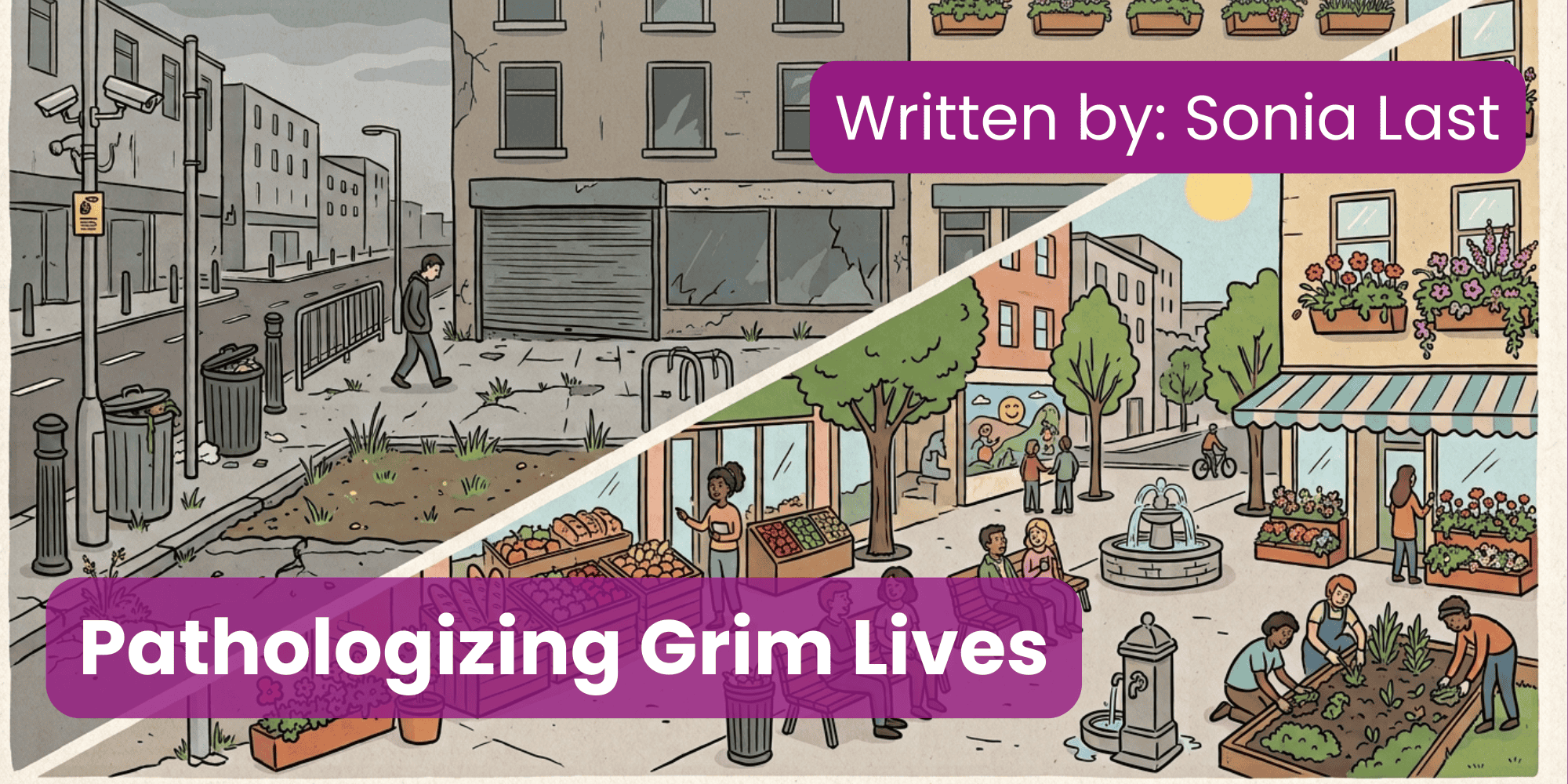
I’m not a psychologist, town planner or social scientist but a glaringly obvious contributor to poor mental wellbeing in the UK must be the ugliness of much of our built environments. Add in grey weather, financial hardship and anti-social behaviour and you have the recipe for a grim existence. Our cities, towns and suburbs have been sorely neglected, and people have become stressed and dispirited.
In global term the UK ranks 23rd for happiness and 24th for quality of life. These stats indicate that we’ve lost our human values to vested interests. The macro analysis masks the personal, day-to-day experience of nearly 70 million people, on our streets and in our communities. Our politicians, economist and diplomats need to set our course in a more positive direction and local authorities need creative vision and listening ears.
Ugly Streets and small comforts
In my city, ugly metal street furniture like railings, cameras, dustbins, bollards and mysterious metal boxes proliferates the landscape. Our cityscapes are littered with sterile spaces and utilitarian metal impediments, but a seat at a bus stop, a handy bench or a public convenience are nowhere to be found. Crowd control and surveillance trump any people-centered comforts or any art or design enhancements. Small comforts are denied to the whole population to sweep social ills like homelessness, addiction and mental ill health down the culverts, because it is easier and cheaper to punish all of us than to provide social supports.
Visually consuming our environments
Psychogeography tells us that we absorb and visually consume the environments we inhabit, so they have a profound effect on our mental wellbeing, our attitudes and our ability to thrive. If our urban landscapes shape our behaviour, we shouldn’t be surprised at the consequences of a low civic engagement and quality of life. Many of us live in grim neighbourhoods, without green space or amenities, except perhaps a strip of dog fouled grass, a forest of metal street furniture and some run-down, uninspiring shops. This poverty of mind is the result of many decades of social incoherence and a lack of pride of place and leadership.
Commerce and Councils
Desperate for a coat of paint, appealing presentation or tidy upkeep, our commercial spaces are an affront to civilisation. Dirty shop fronts, weeds and broken masonry reveal the lethargy and disinterest of both landlords and the council. These cultural vacuums breed estrangement; deplete social and commercial capital and thwart opportunity and investment. We know money is tight but the lack of pride of place is utterly disheartening and unacceptable.
In Portugal, local councils give every household soil, plants and the equipment to create flower boxes and beds which spill over balconies and beautify the streets. Fresh food markets, independent traders and recreational facilities are central to almost every neighbourhood and the residents contribute to the maintenance and upkeep of their shared spaces.
Curable social ills
I’m told that attempts at beautifying our surroundings are too often met with vandalism and destruction. I’m sure that’s true but does that mean we just give up and let the crime, litter and anti-social behaviour rule our streets? Some of us know what this looks like when left unchecked and the results are near impossible to reverse once they take hold. A contagion of poor social behaviour is taking over our streets from many different sources, and we are feeling helpless to combat it. Fear, helplessness, disengagement and isolation are the natural consequences. Charles Dickens and Henry Mayhew would recognise these for what they are - not medical conditions, but curable social ills.
We need to activate our communities so that pride of place becomes an ingrained habit and vital element of our shared culture. Our health, happiness and future depend on it. Like my granny, who after polishing the entrance to her Gorbals close, would cuff anyone around the ear who messed up her handiwork, we need to re-invigorate that moral fibre and respect for community with sharp political teeth that can enforce it.
Cultural directions
The Algerian writer Albert Camus reflected on how poverty in a warm, sun-drenched country is vastly different to poverty in a cold, industrial city. We don’t have the natural comforts of sunshine and the many of the joys that money can’t buy, but we can learn from other countries on changing the trajectory of our quality-of-life indexes so that the future generations inherit a culture and country worth living in.
Tackling the social causes of poor mental health rather than pathologizing people’s dispirited souls is something we need to face. Decades of political in-fighting and commercial greedy have decimated our civic clout and wellbeing. We can’t let this keep happening because whether it’s a government, a civic body or a private enterprise, it’s inevitable that, ‘a bad system will beat a good person every time.’ (W. Edwards Deming).
Written by MHScot Team Member, Sonia Last.